Why homeowners choose us
Fast Response
Quick scheduling and rapid help when water is actively entering.
Transparent Pricing
A clear quote after inspection and before any work starts.
Fully Insured
The contractors we work with carry insurance, explained before any work begins.
Local Expertise
Experienced waterproofing crews who know Central Ohio homes.
Our process
- 1
Test Pump
We test the pump, float, check valve, and discharge line.
- 2
Size System
We match the pump and pit to your water volume.
- 3
Install Pump
The pump, check valve, and discharge line go in.
- 4
Test Run
We run the system and show you how to check it.
What does sump pump installation involve in a Columbus basement?
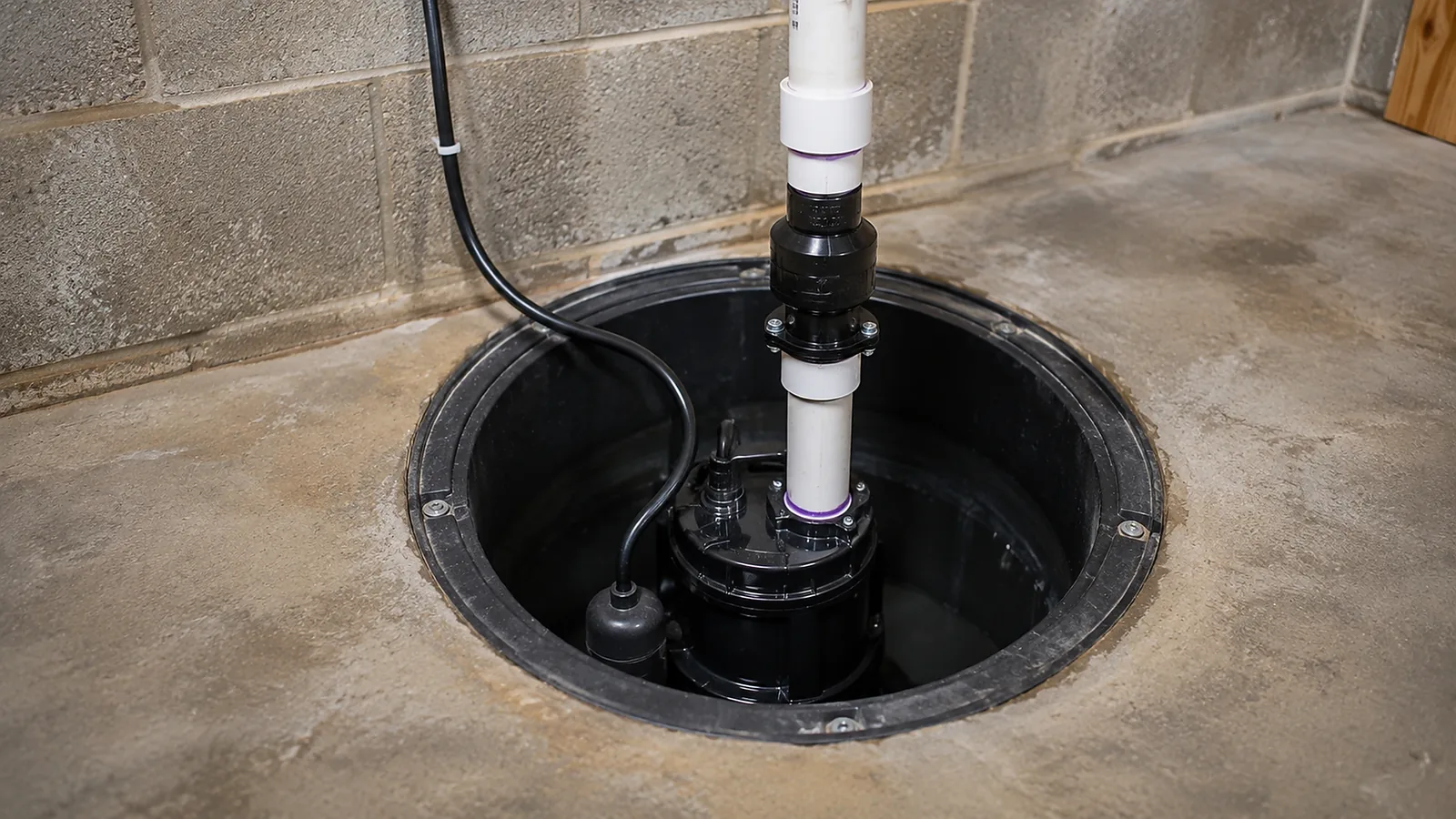
Sump pump installation means setting a pump in a pit at the lowest point of the basement floor so it can push groundwater out of the house before it reaches the slab. In a Columbus basement the finished system has a pit, a pump, a check valve, a discharge line, and a dedicated electrical outlet.
The scope depends on whether a pit already exists. Replacing a pump in an existing pit is mostly a swap of the pump, check valve, and fittings, and it is often finished in a couple of hours. A first-time installation takes longer, because the crew has to open the slab and the new concrete needs time to cure. A typical first-time job covers these steps:
- Cut and remove a section of the basement slab where the pit will sit
- Dig an 18 or 24 inch pit, then set the liner on a gravel base
- Set the pump, add the check valve, and wire it to its own outlet
- Run the discharge line through the rim joist and out of the house
- Fill the pit with water to confirm the float lifts and the pump empties it
That last test matters. A pump that has never been run against a full pit has only been assumed to work.
Pit placement is part of the job. The pit usually goes at the lowest spot on the slab or near the wall where water shows up first, with enough room around it that the float can swing freely and the pump does not rub the liner. A good crew checks the slope of the floor before cutting, because a pit set a few feet off the low point fills later than the water on the floor does.
Why do Columbus basements need a sump pump?
Columbus basements need sump pumps because heavy rain and slow-draining clay soil send groundwater against the foundation faster than the ground can carry it away. The city averages about 39.3 inches of precipitation a year, and the National Weather Service recorded 55.18 inches in 2018, the wettest year on record there. July is the wettest month, at about 4.7 inches on NOAA’s 1991 to 2020 averages.
The storms are also getting more concentrated. Ohio State research found that Columbus days with more than 1.25 inches of precipitation rose 78% between 1951 to 1980 and 1981 to 2010. On August 20, 2026, a single day brought 2.87 inches, a record for that date, according to Axios and the National Weather Service. A pit that sits empty for three weeks can fill in an afternoon, and that is the situation a sump pump exists for.
Soil adds to the problem. Franklin County soils formed on glacial till with a lot of silt and clay, and clay holds water against the foundation instead of passing it along. A basement that stays dry through a normal year can still take on water in a wet spring, which is why many owners only learn they need a pump after the first flood.
How much does sump pump installation cost in Columbus?
Sump pump installation in Columbus most likely falls between about $650 and $2,100 for a basement pump, since HomeAdvisor’s survey of 1,663 homeowners found a typical range of $642 to $2,097 and an average of $1,347. No Columbus-specific average has been published, so these are national benchmarks.
Other sources land in the same area. Angi lists $800 to $3,000 with an average near $1,100, and This Old House, using Fixr and Angi data, reports about $1,400 for a new pump and pit, or as little as $500 when the pit and piping already exist. Replacing only the pump costs $309 to $749 on Angi, with a $525 average. Location moves the price: Angi averages $1,200 for a basement install and $3,900 for a crawl space, because tight access slows the crew. Labor is usually billed at $45 to $200 an hour, and a running pump adds $30 to $50 a year in electricity. A battery backup, a longer discharge run, or new electrical work will raise any quote.
Doing the job yourself looks cheaper on paper: Angi puts DIY installs at $300 to $800 and professional ones at $800 to $3,000. The gap is mostly the slab work, the permit, and the electrical connection. Ask every contractor for the quote in line items, so you can see what the pit, the pump, the backup, and the permit each cost instead of comparing one total against another.
Which sump pump type and size fit a Columbus basement?
A submersible pump under a sealed lid fits most Columbus basements, because the motor sits underwater, runs quieter, and moves more water than a pedestal pump. Angi lists installed submersible pumps at $1,200 to $3,000. Pedestal pumps, with the motor on a stalk above the pit, run $800 to $1,500 and are easier to reach, but they are louder and the open pit lets humidity and odor into the room.
Size comes down to gallons per hour at your real lift, meaning how far the pump has to raise the water to reach the discharge outlet. Pentair says 1/3 and 1/2 horsepower are the most common choices, and both oversizing and undersizing shorten a pump’s life, because a pump that is too big short cycles and one that is too small never stops. In a standard 18-inch pit each inch of rise holds about one gallon, so timing how fast the pit fills during a hard rain tells you how much water the pump has to move.
Construction matters as much as horsepower. Cast iron housings shed heat better than plastic, which is a large part of why they cost more, and a vertical float switch is less likely to snag on the side of the pit than a tethered one. Ask which model the contractor plans to use, and look up its flow rating at your lift height, not the number printed on the box.
Does a Columbus home need a battery backup?
A Columbus home should have a battery backup if the basement has flooded before, because the storms that fill a sump pit also knock out power. Angi puts a battery backup system at about $900 on average, with a range of $600 to $1,200, and suggests budgeting $50 to $150 every few years to replace the battery.
A water-powered backup needs no battery, and Angi lists them at $1,200 to $2,500 installed. It does need municipal water pressure, so it will not work on the private wells that still serve some homes in unincorporated Franklin County. Either backup only protects the basement if it is tested. Pour water into the pit twice a year, once before spring and once in the fall, and confirm that the backup pump starts when the main pump is unplugged.
Runtime is the number to ask about. A battery lasts for a limited number of hours depending on its size and how often the pump cycles, and a long Columbus storm with a high water table can drain it faster than a short one. Ask the installer for the expected runtime at your pit’s fill rate, keep the battery on its charger, and consider a high-water alarm so you hear about a problem before you see it.
Where should a sump pump discharge in Columbus?
A sump pump should discharge outdoors, well away from the foundation, and never into the sanitary sewer. Clean groundwater in a sanitary line overloads the sewer system and can back up into basements, which is why Columbus suburbs such as Bexley and Grandview Heights prohibit connecting storm or ground water to sanitary sewers in their codes. Columbus City Code 1145.86 separately prohibits sending anything other than stormwater into the city storm sewer. Ask your city or township which outlet applies to your lot before the line is run.
Most homes discharge to the yard, onto ground that slopes away from the house. A check valve on the line keeps the water in the pipe from dropping back into the pit after each cycle. Franklin County uses a 32-inch frost depth for construction, so the outlet end can freeze or get buried in snow, and a blocked line sends water straight back to the pit. Check the outlet after any hard freeze. Keep the outlet clear of sidewalks, driveways, and a neighbor’s lot, because a stream of water that freezes across a walkway is a hazard and many cities regulate it.
How long does a sump pump last, and when should you replace it?
A sump pump lasts about 7 to 10 years with regular maintenance, so a Columbus pump older than that is working on borrowed time. Replacement in an existing pit costs $309 to $749 on Angi, which is far less than the cost of a flooded basement. Our guide on how long a sump pump lasts in an Ohio basement explains the testing schedule and battery life. Watch for these signs:
- The pump runs nonstop, or cycles on and off every few seconds
- Grinding, rattling, or a motor that hums without moving water
- Rust on the housing, or grit and silt clogging the pit
- The pump is more than 7 years old, or nobody knows its age
Run the bucket test before the wet spring months: pour water into the pit, and the pump should start, empty the pit, and shut off cleanly. Keeping basement humidity below 60%, ideally 30% to 50% as the EPA advises, also protects the pump and the finished space around it.
Most pump failures trace back to a short list of causes. Angi names a stuck float switch, a damaged or tangled wire, and a pump that is too small for the water volume, and notes that frequent outages bring power surges that can burn out the motor. Columbus storms tend to deliver outages and heavy rain together, so a pump that is only a few years old can still fail if the float sticks or the intake clogs. Cleaning the pit and checking the float costs nothing and takes ten minutes.
How do you hire a sump pump contractor in Columbus?
Hire a Columbus sump pump contractor who will pull the right plumbing permit, name the pump model in writing, and show proof of insurance. According to PermitFlow’s Columbus guide, the city requires plumbing permits for new installations and a licensed plumber must pull them. Franklin County also requires a valid license for plumbing work, and in many Franklin County suburbs plumbing permits go through Franklin County Public Health. New Albany’s application form lists sump pumps among its fee items. Because the office differs by address, ask the contractor which one covers your home.
Before you sign, ask for these in writing:
- The pump make and model, the pit size, and the discharge route
- Whether the price includes the permit, the backup, and electrical work
- Proof of liability insurance; the contractors we work with carry insurance coverage, and you should still ask to see it
- Warranty terms for the pump and for the labor
Also ask what happens if the pump fails during the first winter, and who comes back to fix it. A contractor who can answer both questions without hesitation, has done this work before. Compare bids line by line, and be cautious of any quote that is far below the others without a clear reason.
When to call a professional. Call if your pump is older than 7 years, runs constantly, cycles on and off rapidly, makes grinding noises, or did not run during the last storm. A failed pump can let water reach the floor in the next heavy rain.